You have a website. You post on Instagram when you find the time. Maybe you even tried boosting a post or two. And yet, the phone doesn’t ring as often as you’d like.
If that sounds familiar, you’re not alone. I speak with small business owners every week who are doing “some” digital marketing but aren’t seeing steady enquiries. The problem is rarely effort. It’s usually the lack of a clear plan that connects the right channels to the right customers.
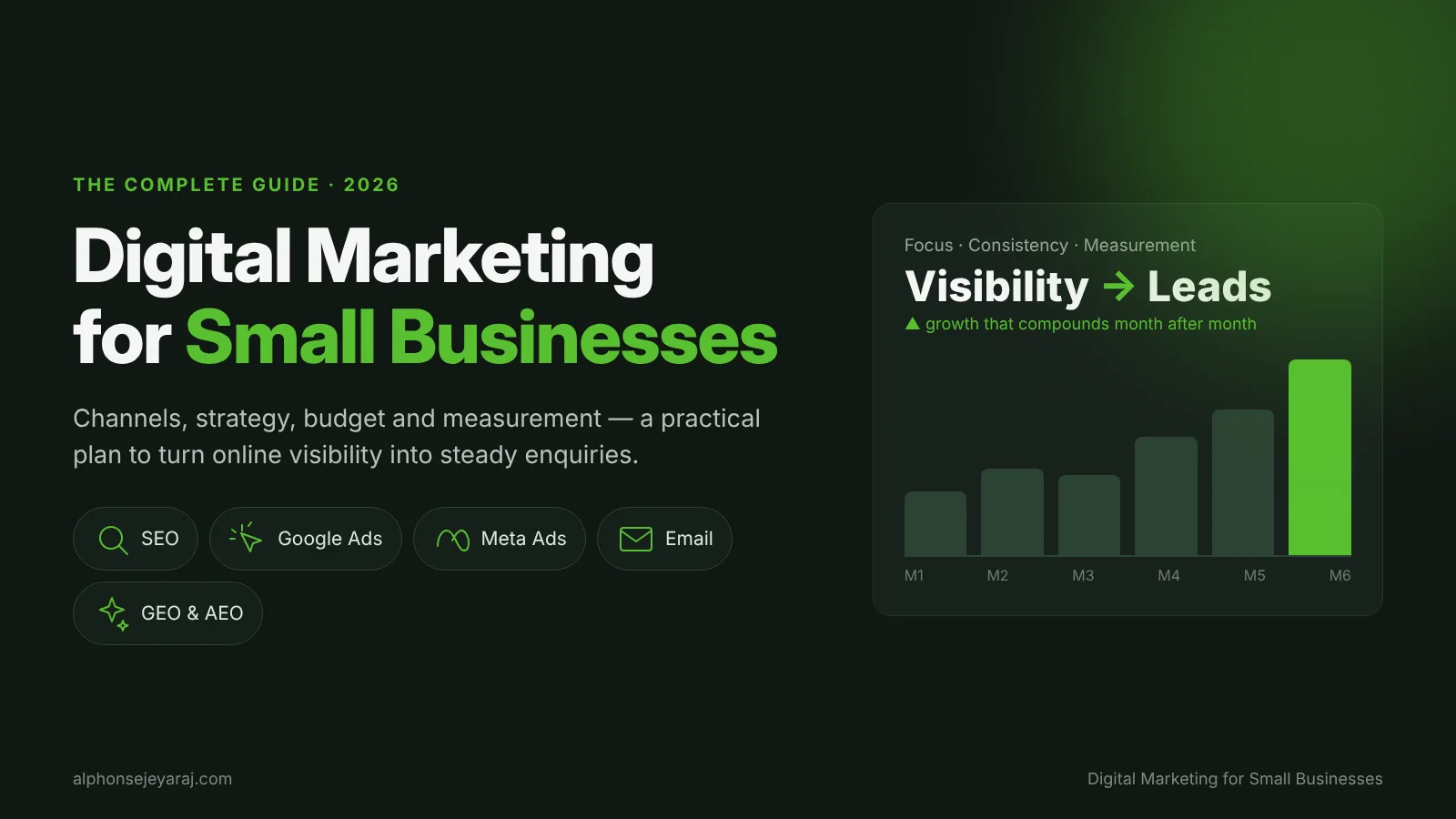
That’s what this guide is about. Digital marketing for small businesses doesn’t need a huge budget or a full marketing team. It needs focus, a few well-chosen channels, and the habit of measuring what works.
Key takeaways
- Digital marketing helps small businesses get found at the exact moment customers are searching, comparing and deciding.
- You don’t need every channel. Start with one or two that match how your customers buy, such as local SEO, Google Ads or Meta Ads.
- A simple 7-step plan — goals, audience, research, channels, content, budget and measurement — keeps your marketing focused.
- Test a budget you can sustain for at least three months, then scale the channels that bring in qualified leads.
- Judge success by enquiries, sales and return on ad spend, not likes and impressions.
In this guide:
- What is digital marketing for small businesses?
- Why digital marketing matters
- Key benefits
- The best digital marketing channels
- How to create a digital marketing strategy
- How much digital marketing costs
- Common mistakes to avoid
- How to measure performance
- Should you hire a freelancer?
- FAQs
What Is Digital Marketing for Small Businesses?
Digital marketing for small businesses is the use of online channels – search engines, social media, email, websites and online ads – to reach people who are likely to buy from you.
Think of it as the online version of everything you already do to win customers. Instead of handing out flyers, you show up when someone searches “plumber near me”. Instead of waiting for word of mouth, you share helpful content that people pass along. Instead of guessing which advert worked, you can see exactly how many people clicked, called or bought.
The big difference between small business digital marketing and what large brands do is scale. A big company can afford to be everywhere. A small business has to be smart about where it shows up, and that’s actually an advantage. You can move faster, speak more personally, and focus on the customers who matter most to you.
Why Is Digital Marketing Important for Small Businesses?
Because that’s where your customers are looking. Before most people call a business, visit a shop or book a service, they search online, read reviews and compare options. If you’re not visible at that moment, your competitor gets the enquiry.
Good digital marketing helps you:
- Improve your online visibility, so people find you when they need what you offer
- Generate leads consistently, instead of relying only on referrals
- Win new customers in areas or markets you couldn’t reach before
- Measure results, so you know exactly where your money is going
- Compete with bigger brands, because a focused small business can outrank or outperform a large one in its niche
The Main Benefits of Digital Marketing for Small Businesses
- You can target the right people. Online platforms let you reach people by location, interests, age, search behaviour and more. A bakery in Coimbatore doesn’t need to pay to reach people in Delhi.
- You can see what’s working. Unlike a newspaper ad, almost everything online can be tracked — clicks, calls, form fills, sales. That turns marketing from guesswork into decisions.
- You can start small. You don’t need lakhs to begin. You can test a channel with a modest budget, learn from the data, and scale what works.
- You build relationships, not just reach. Social media, email and helpful content let customers get to know you before they buy. That trust makes selling much easier.
- You grow brand awareness over time. Every blog post, review and satisfied customer adds to your reputation online. Unlike an ad that disappears, much of this keeps working for you.
The Best Digital Marketing Channels for Small Businesses
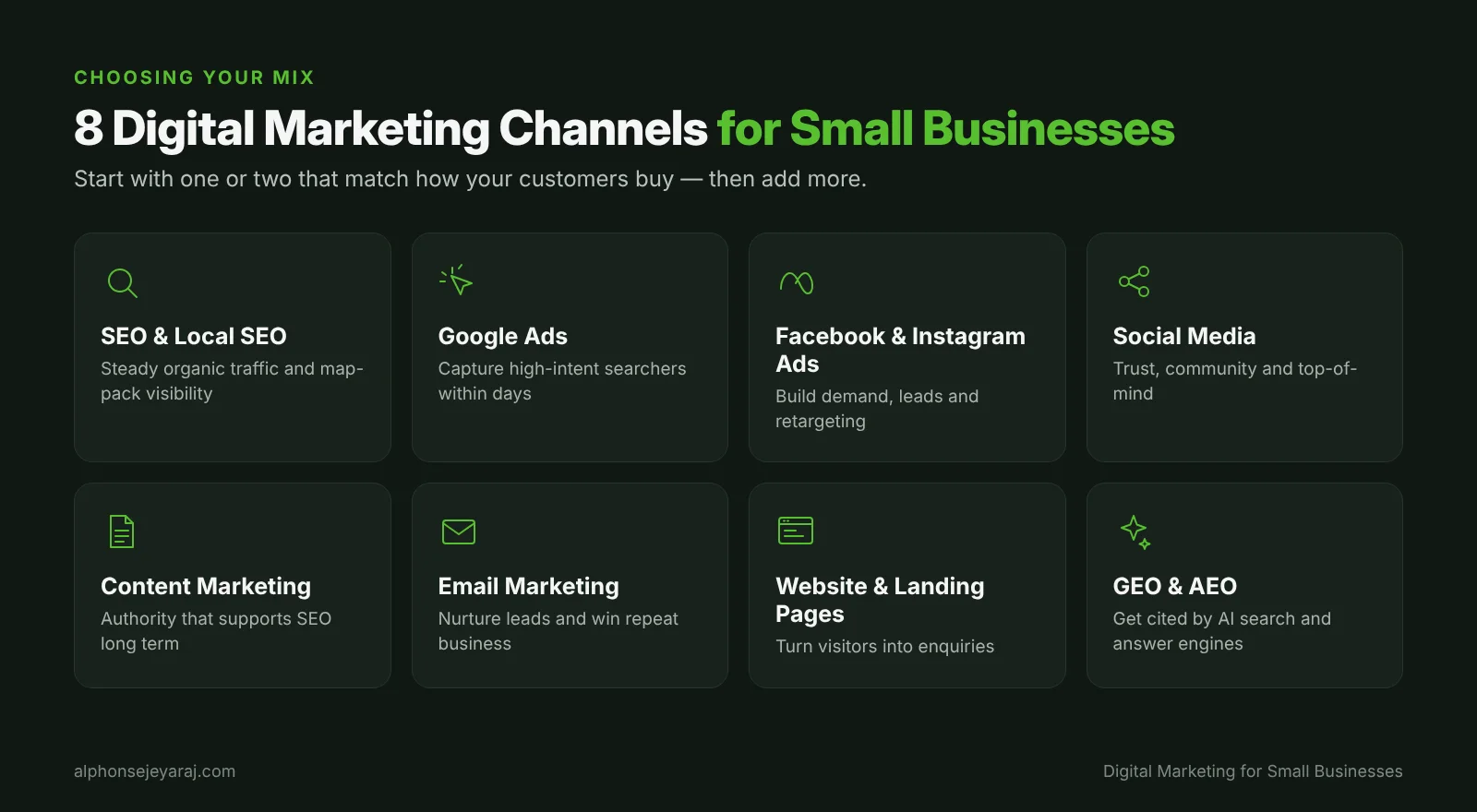
There’s no single “best” channel. The right mix depends on what you sell, who buys it and how they make decisions. Here’s a plain-English look at the main options, and when each one makes sense.
Search Engine Optimisation (SEO)
SEO is the work of helping your website appear in Google’s free (organic) results when people search for what you offer. It covers keyword research, improving your pages, fixing technical issues that slow your site down, and building trust through quality content and links.
For local businesses, local SEO is especially powerful. A well-optimised Google Business Profile, accurate contact details and genuine reviews can put you in the map results when someone nearby searches for your service. Follow this step-by-step guide to Google Business Profile optimisation.
Best for: long-term, steady traffic and enquiries. Keep in mind: SEO takes time. Expect months, not weeks, before you see strong results. If you’d like expert help, explore my SEO services for small businesses.
Google Ads and Paid Search Advertising
Google Ads lets you pay to appear at the top of search results for specific keywords. You only pay when someone clicks, and you control your daily budget.
The magic of search ads is intent. The person is already looking for what you sell. With good keyword targeting, sensible budgets and proper conversion tracking, Google Ads can bring in leads within days.
Best for: quick results and capturing people ready to buy. Keep in mind: results stop when spending stops, and poorly managed campaigns can waste money fast. That’s where professional Google Ads management pays for itself.
Facebook and Instagram Advertising
Meta Ads (Facebook and Instagram) let you reach people based on who they are and what they’re interested in, even if they aren’t searching for you yet. They work well for building demand, generating leads through instant forms, and retargeting people who visited your website but didn’t take action.
Success here depends heavily on creative. Testing different images, videos and messages is how you find what clicks with your audience.
Best for: visual products, local offers, events and lead generation. Learn more about my Facebook and Instagram Ads management.
Social Media Marketing
Organic social media is about showing up consistently, sharing useful or entertaining content and talking with your audience. You don’t need to be on every platform. Pick the one or two where your customers actually spend time – Instagram for lifestyle and retail, LinkedIn for B2B services, for example.
Best for: trust, community and staying top of mind.
Content Marketing
Content marketing means creating helpful material — blog posts, guides, videos, case studies — that answers your customers’ questions. (You’re reading an example right now.) Good content attracts search traffic, shows your expertise, and gives you something valuable to share on social media and email.
Best for: building authority and supporting SEO over the long run.
Email Marketing
Email is one of the most underrated channels for small businesses. You own your email list, unlike your social media followers. Use it to send newsletters, follow up with enquiries, share offers and bring past customers back.
Best for: nurturing leads and increasing repeat business.
Website Development and Landing Page Optimisation
Every channel above sends people somewhere — usually your website. If that website is slow, confusing or hard to use on a phone, you lose the customer you just paid to attract.
A strong small business website loads quickly, explains clearly what you do, builds trust with reviews and examples, and makes the next step obvious with a clear call to action. For ad campaigns, dedicated landing pages focused on one offer usually convert far better than a general homepage. If your site needs work, see my WordPress website development service.
Generative Engine Optimisation (GEO) and Answer Engine Optimisation (AEO)
More people now ask questions to AI tools like ChatGPT, Gemini and Google’s AI Overviews instead of scrolling through search results. GEO and AEO are about making your content easy for these systems to understand, trust and quote.
In practice, that means answering common questions clearly and directly, keeping your facts accurate and up to date, structuring pages with clear headings, and building a consistent, credible presence across the web. It’s a newer field, but the businesses that prepare now will have an edge. Find out more about Generative Engine Optimisation (GEO) and Answer Engine Optimisation (AEO).
How to Create a Digital Marketing Strategy for a Small Business
A digital marketing strategy is simply a plan that answers three questions: what do you want, who are you trying to reach, and how will you reach them? Here’s the seven-step framework I use with clients.
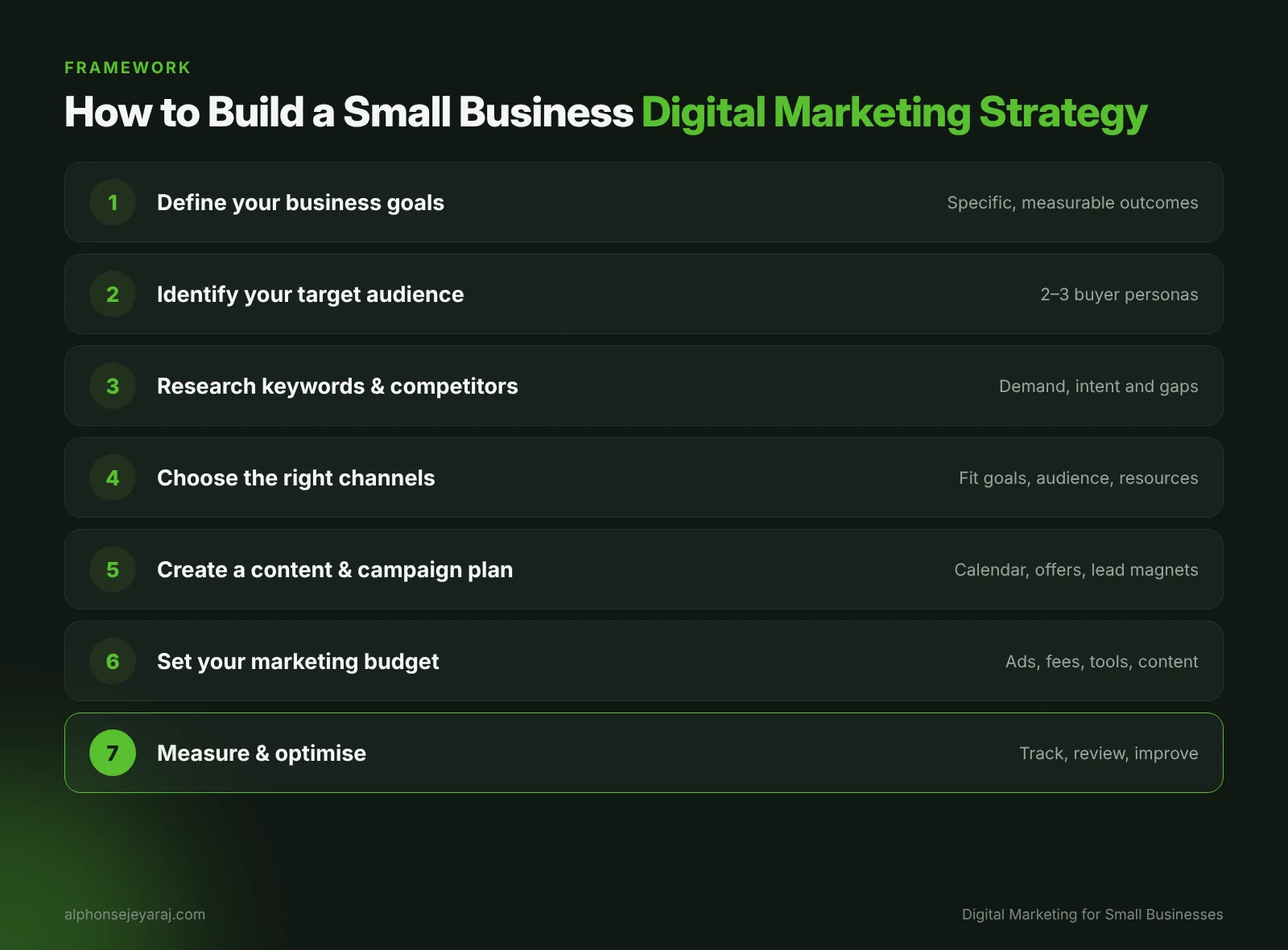
Step 1: Define Your Business Goals
Start with the business outcome, not the marketing activity. “Post on Instagram daily” is a task. “Get 30 qualified enquiries a month” is a goal.
Good goals are specific and measurable. Examples: generate more leads for a service, increase online sales, get more footfall to a shop, or rank in the local map results for your main service.
Step 2: Identify Your Target Audience
Who is your ideal customer? What problem are they trying to solve? Where do they look for answers, and what makes them choose one business over another?
Write a short description of two or three typical customers (often called buyer personas). It sounds basic, but it shapes every decision that follows — from the words you use in ads to the platforms you choose.
Step 3: Research Keywords and Competitors
Find out what your customers actually type into Google. Tools like Google Keyword Planner can help you see which searches have real demand. Pay attention to search intent: someone searching “how to fix a leaking tap” wants advice, while “plumber near me” wants to hire someone today.
Then look at your competitors. Which keywords do they rank for? What do their websites and ads look like? Where are the gaps you can fill?
Step 4: Choose the Right Marketing Channels
You don’t need to do everything. Pick channels that fit your goals, your audience and your resources. A few common patterns:
- A local service business (clinic, salon, repair service) often gets the best results from local SEO, Google Ads and reviews.
- An ecommerce brand typically relies on Google Shopping, Meta Ads, email and retargeting.
- A B2B company usually benefits most from SEO, content marketing, LinkedIn and email nurturing.
Start with one or two channels and do them well before adding more.
Step 5: Create a Content and Campaign Plan
Map out what you’ll publish and promote, and when. That might include a monthly content calendar, ad campaigns around key seasons or festivals, special offers, and lead magnets like a free guide or consultation.
A simple spreadsheet is enough. The point is consistency, not complexity.
Step 6: Set Your Marketing Budget
Decide how much you’ll invest and where it goes. Remember to account for everything: ad spend, freelancer or agency fees, tools and software, content creation, and website improvements. We’ll look at digital marketing costs in more detail below.
Step 7: Measure Performance and Optimise Campaigns
Set up tracking from day one — Google Analytics, conversion tracking in your ad accounts, and call or form tracking on your website. Review your numbers regularly, keep what’s working, fix or pause what isn’t, and test new ideas.
Digital marketing isn’t “set and forget”. The small, steady improvements are where the real gains come from.
How Much Does Digital Marketing Cost for a Small Business?
The honest answer: it depends. Anyone who quotes a single number for every business is guessing. What I can do is show you what goes into the cost, so you can plan sensibly.
Your digital marketing budget usually has four parts:
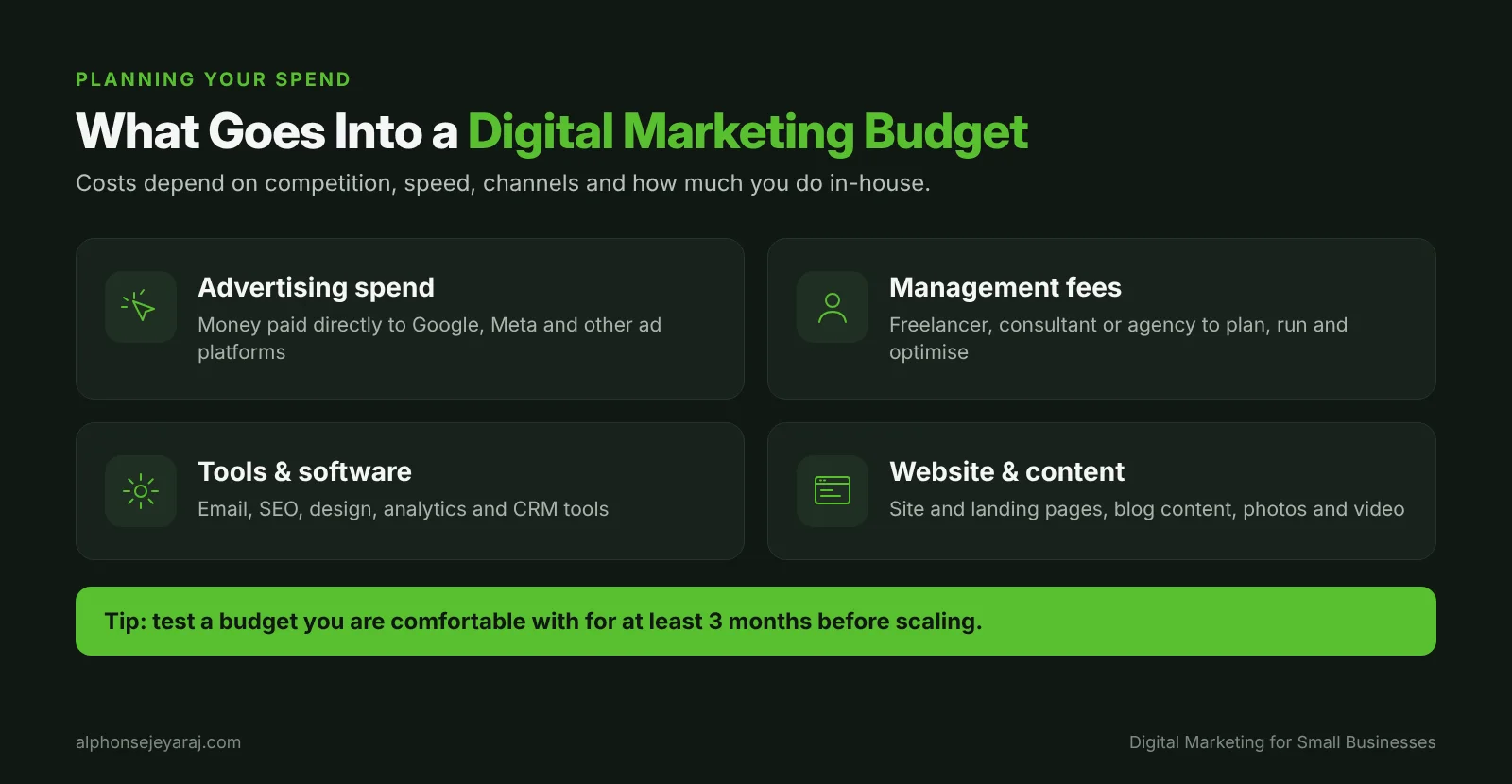
| Cost type | What it covers |
|---|---|
| Advertising spend | The money paid directly to Google, Meta or other platforms for your ads |
| Management fees | What you pay a freelancer, consultant or agency to plan, run and optimise your marketing |
| Tools and software | Email platforms, SEO tools, design apps, analytics and CRM software |
| Website and content | Building or improving your website, landing pages, blog content, photos and videos |
The main factors that push costs up or down are how competitive your industry is, how quickly you want results, which channels you use, and whether you handle any of the work yourself.
My advice: start with a budget you’re comfortable testing for at least three months. That’s usually long enough to gather real data and see which channels deserve more investment.
Common Digital Marketing Mistakes Small Businesses Should Avoid
I’ve seen these mistakes cost businesses a lot of money and patience. The good news is that every one of them is fixable.
- No clear goals. Without a target, you can’t tell whether your marketing is working.
- A weak website. Sending traffic to a slow or confusing site is like inviting guests to a locked shop. A fast, conversion-focused website fixes this.
- Poor or missing tracking. If you can’t see which channel brought in a lead, you can’t make smart budget decisions.
- Targeting everyone. Broad targeting wastes money. The more specific your audience, the better your results.
- Inconsistent effort. Posting for two weeks, then disappearing for two months, rarely builds momentum.
- Chasing vanity metrics. Likes and impressions feel good, but enquiries and sales pay the bills.
- Expecting overnight results. SEO and content take time. Even ads need a learning period before they perform at their best.
How to Measure Digital Marketing Performance
The goal of measurement is simple: connect what you spend to what you earn. Here are the metrics that matter most, roughly in the order a customer moves through them.
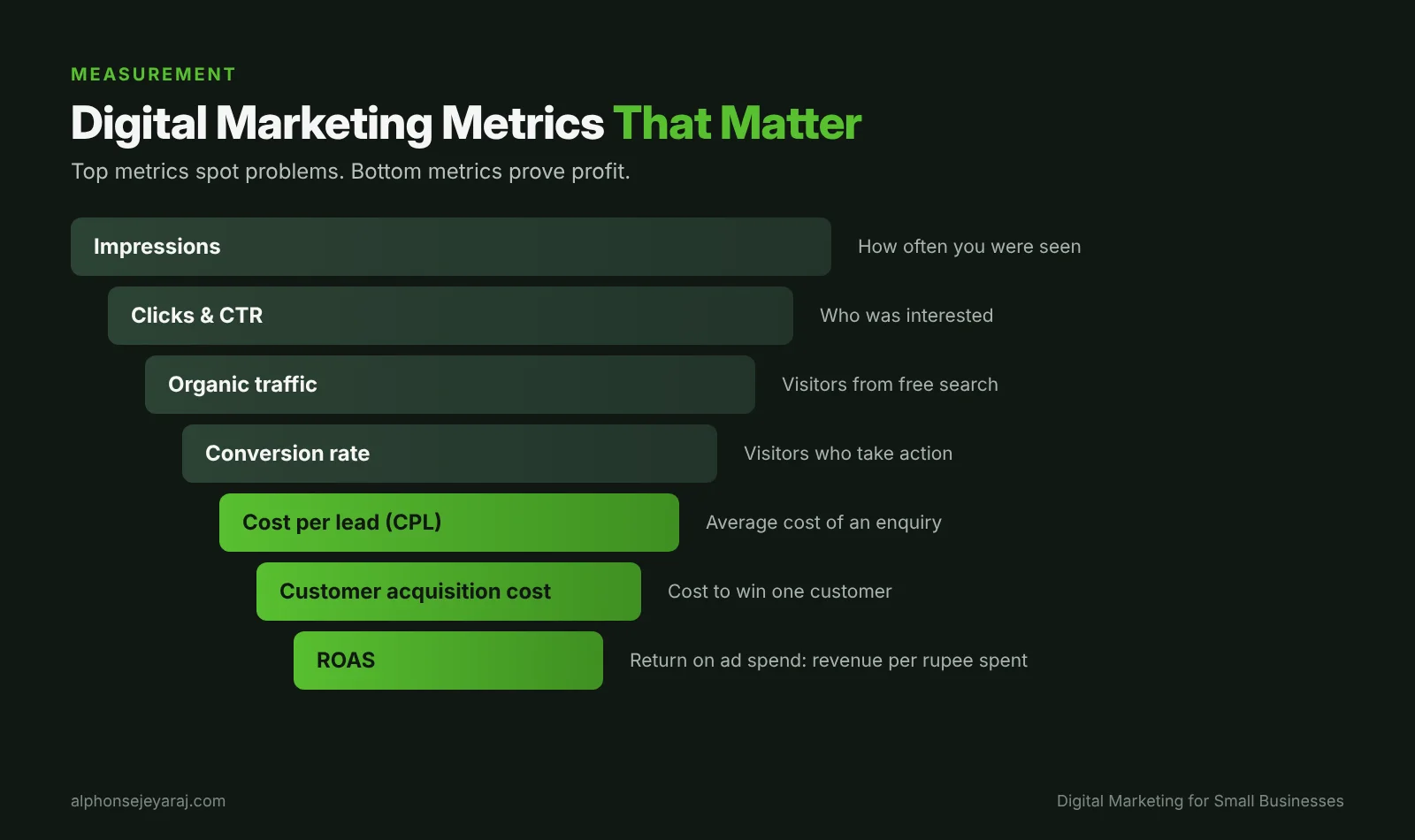
| Metric | What it tells you |
|---|---|
| Impressions | How many times your ad or content was seen |
| Clicks and click-through rate (CTR) | How many people were interested enough to click |
| Organic traffic | How many visitors arrive from free search results |
| Conversion rate | The percentage of visitors who take action (call, enquire, buy) |
| Cost per lead (CPL) | How much you pay, on average, for each enquiry |
| Customer acquisition cost (CAC) | What it costs to win one paying customer |
| Return on ad spend (ROAS) | Revenue earned for every rupee spent on ads |
The top of that list is useful for spotting problems. The bottom is what tells you whether your marketing is actually profitable. Always look past clicks to qualified leads, sales and revenue.
Should You Hire a Digital Marketing Freelancer for Your Small Business?
If you’re short on time, unsure where to start, or tired of spending money without clear results, hiring help can make a lot of sense.
A freelance digital marketing specialist is often a good fit for small businesses because you work directly with the person doing the work. There are no account managers in between, costs are usually more flexible than a large agency, and you get a strategy built around your business rather than a template. (I cover this in more depth in why businesses hire freelancers.)
Before hiring anyone, ask:
- Do they have experience with businesses like yours?
- Can they show real results, case studies or references?
- Will they explain their strategy in plain language?
- How will they report on performance, and how often?
- Do they focus on leads and sales, or just clicks and followers?
A good freelancer should make your marketing clearer, not more confusing. You can learn more about my background or browse my freelance digital marketing services.
Frequently Asked Questions About Digital Marketing for Small Businesses
What is the best digital marketing strategy for a small business?
The best strategy is one built around your specific goals and customers. For most small businesses, that means a strong website, a clear focus on one or two channels that match how customers buy, and consistent tracking to improve over time.
How much should a small business spend on digital marketing?
There’s no fixed number. It depends on your industry, competition, goals and growth plans. Begin with an amount you can sustain for at least three months, measure the return, and increase spending on channels that prove profitable.
Is SEO or Google Ads better for a small business?
They do different jobs. Google Ads brings faster results but stops when you stop paying. SEO takes longer but builds lasting, free traffic. Many small businesses use Google Ads for immediate leads while investing in SEO for the long term.
How long does digital marketing take to produce results?
Paid ads can generate leads within days, though campaigns usually improve over the first few weeks. SEO and content marketing typically take several months to build momentum. Consistency matters more than speed.
Get Help with Digital Marketing for Your Small Business
Digital marketing for small businesses doesn’t have to be overwhelming. Set clear goals, understand your customers, choose a few channels that fit, and measure everything. Do that consistently, and you’ll be ahead of most of your competitors.
If you’d rather have an experienced hand guiding the process, I’d be glad to help. I work with small businesses on Google Ads, Meta Ads, SEO, GEO, AEO and WordPress websites — always with a focus on real leads and sales, not just numbers on a dashboard.
Let’s talk about your business goals
Book a free consultation. I’ll review your current marketing and show you which channels can bring in more qualified leads for your small business.